
 My Testimony
Rebekah
The Resilient Matriarch with a Heart of Purpose and Quiet Strength
By Neil McBride, Founder and CEO of Downtown Angels

Introduction
Rebekah, the wife of Isaac and the mother of Jacob and Esau, stands out as one of the most compelling and complex women in the entire biblical narrative. Her story, primarily told in Genesis chapters 24-27, occupies a pivotal role in the unfolding history of God’s covenant people. She is not simply a supporting character in the patriarchal drama of Abraham’s descendants. She is a key player whose choices, convictions, and character have a profound impact on the narrative’s course and Israel’s future.
Rebekah’s introduction is striking and memorable. She appears first as a young woman in the town of Nahor, radiant in appearance but even more remarkable for her generosity, hospitality, and energy. Her willingness to draw water not only for Abraham’s servant but also for his camels, a demanding and labour-intensive task, reveals a heart of kindness and servant-like diligence. From the outset, Rebekah’s actions distinguish her as a woman of both grace and strength, someone with a deep sense of purpose and readiness for the unknown.
Her marriage to Isaac, the quiet son of Abraham and Sarah, marks the beginning of a new chapter in the divine story. But Rebekah is not a silent figure in her household. She emerges as a discerning and proactive woman of strong convictions and intuitive insight. When her twin sons Jacob and Esau struggle within her womb, she does not dismiss the spiritual significance of their conflict. She goes directly to God, seeking understanding and guidance. When the time comes to act on the divine word she received that the older would serve the younger, Rebekah demonstrates boldness and agency, making controversial decisions to secure what she believes is God’s intended blessing.
Her story is layered with wisdom and tension. Rebekah is at once a model of spiritual attentiveness and a figure of familial disruption. Her actions, particularly in helping Jacob obtain Isaac’s blessing through deception, have sparked centuries of debate among theologians and ethicists. Was she simply manipulative, or was she courageously ensuring God’s will would be fulfilled despite human blindness? Was her discernment a sign of faith, or did her methods undermine the unity of her household?
Regardless of how one interprets her actions, Rebekah’s legacy is undeniably influential. She shaped the path of the chosen lineage. She took risks. She made hard choices. And in doing so, she became a mother not just of Jacob but of a nation. Her story is a vivid reminder that women in Scripture were not merely background figures; they were integral to the narrative. They were often central to God’s unfolding plan.
Rebekah’s World: The Historical and Cultural Backdrop
Rebekah lived during the Middle Bronze Age, approximately between 2000 and 1800 BCE—a period marked by the emergence of early civilisations, thriving trade routes, and the development of city-states across the ancient Near East. This was a time when patriarchal structures governed society, family life was centred on clan loyalty and inheritance, and spiritual understanding was deeply tied to ancestral worship and covenantal beliefs. Nomadic tribes moved across vast landscapes, raising flocks, digging wells, and following seasonal rhythms of survival, trade, and worship.
In this context, women were frequently marginalised within legal and social systems. They had few rights outside of marriage and motherhood. However, within the household, women, particularly matriarchs, could exert profound influence. Figures like Sarah, Rebekah, Rachel, and Leah were not mere background characters in Israel’s story. They were decision-makers, intercessors, and bearers of generational promises. Rebekah, in particular, emerged as a matriarch whose voice, vision, and actions directly impacted the unfolding of God’s covenantal plan.
Rebekah came from the region of Mesopotamia, known biblically as Aram-Naharaim. This area, situated between the Tigris and Euphrates Rivers, was a cradle of culture and intellect in the ancient world. Her hometown was closely linked to Abraham’s ancestral roots, reflecting a strong familial and spiritual continuity. Her family, led by her brother Laban, was well-established, wealthy, articulate, and deeply involved in the regional customs of marriage, inheritance, and hospitality. Laban’s later influence on Jacob’s life would further emphasise the interconnectedness of this family within the broader biblical narrative.
Understanding the cultural and historical backdrop of Rebekah’s life helps us appreciate how extraordinary she truly was. In a world where women were often expected to be silent and submissive, Rebekah acted with remarkable agency. She made decisions, interpreted divine messages, and shaped the direction of her family’s legacy. Her strength did not come from social status or official titles but from her character, discernment, and courage to act when others hesitated. In the story of Israel, she is not simply Isaac’s wife. She is a foundational mother of nations, stepping into history with both conviction and wisdom.
Rebekah’s Introduction: Strength, Kindness, and a Servant’s Heart
Rebekah’s first appearance in the Bible is as compelling as it is memorable. Found in Genesis 24, her introduction is the longest and most detailed account of any woman’s betrothal in Scripture, underscoring its significance. Abraham, growing old and concerned about securing God’s promise through Isaac, sends his servant on a mission to find a suitable wife for his son, not from the Canaanites among whom they dwell but from Abraham’s people in Mesopotamia. The servant, aware of the spiritual weight of this assignment, prays for a sign of a woman who will not only offer him water but will also go beyond what is expected and offer to water his camels as well.
It is at this critical moment that Rebekah steps onto the scene. She comes to the well, carrying a jar on her shoulder, and her actions unfold with grace and decisiveness that immediately draw attention. Without hesitation, she offers the weary servant a drink and then, with equal speed and generosity, offers to water all his camels. This task could involve hauling up to 300 gallons of water, given that ten camels are mentioned. This act of service was not just kind—it was exhausting, time-consuming, and physically demanding. Yet she carries it out without complaint, without being asked, and without knowing she is being watched as part of a divine test.
Her actions speak volumes. Rebekah’s hospitality is warm and instinctive; her work ethic is remarkable, and her generosity is genuine and unforced. The text emphasises her eagerness and speed, noting that she “quickly” lowered her jar and “ran” back to the well to draw more water. These are not minor details. They highlight a young woman of energy, initiative, and intentional kindness. She is not merely polite; she is powerful in her compassion.
Rebekah’s Brave Journey: A Woman of Faith and Decision
The moment Rebekah learns the purpose of Abraham’s servant, that he has come to find a wife for Isaac, Abraham’s son, and that God has confirmed Rebekah as the chosen one marks a profound turning point in her life. Her family is understandably hesitant. Though they acknowledge the divine hand in the servant’s arrival, they ask for a delay, requesting ten more days with Rebekah before she departs for a distant and unknown land. But when the question is finally put to her, “Will you go with this man?” Rebekah’s response is immediate and unshaken: “I will go” (Genesis 24:58).
These three simple words are among the most powerful spoken by any woman in Scripture. They reflect far more than consent to a marriage proposal. They signal a bold leap of faith, a willingness to leave the familiar for the sake of a future that she believes is divinely appointed. Rebekah chooses to leave her homeland, her family, her language, her traditions, and the only life she’s ever known. She steps into uncertainty with a resolute spirit and trust in something greater than what she can see.
In an age when women were typically passive in decisions about marriage and destiny, Rebekah speaks with agency. She does not ask questions or bargain for time; she doesn’t ask to meet Isaac first or consider other suitors. She does not act as a captive of tradition but as a woman whose sense of destiny outweighs her fear of the unknown.
Her decision is one of extraordinary courage. She travels hundreds of miles on camelback through a foreign wilderness to become the wife of a man she has never seen. Yet there is no indication of reluctance, no sign of wavering. Rebekah’s faith mirrors that of Abraham himself, as evidenced by his willingness to go “to a land I will show you,” trusting that God’s promises lie at the end of the journey. In this way, she becomes not just a companion for Isaac but a worthy matriarch in the line of covenant bearers. Her story reminds us that faith often requires bold steps, that calling sometimes arrives with little certainty, and that the most meaningful decisions are usually made without guarantees, only with trust.
Rebekah and Isaac: A Deep and Unique Connection
As Rebekah approaches the end of her long journey, the biblical narrative paints a scene of quiet wonder. Isaac is in the field, meditating at dusk, a gentle, contemplative man, perhaps still mourning the loss of his mother, Sarah. When he lifts his eyes and sees the caravan approaching, Rebekah also lifts her eyes, sees Isaac, and immediately covers herself with a veil, a gesture of both modesty and readiness. The servant recounts all that has happened, and then the Scripture gives us one of the most tender and understated verses in the entire book of Genesis:
“Isaac brought her into the tent of his mother Sarah, and he took Rebekah, and she became his wife. And he loved her. So Isaac was comforted after his mother’s death.” (Genesis 24:67)
In that single sentence lies a world of emotional healing and relational depth. Isaac, who had lived in the shadow of his father’s faith and the trauma of near-sacrifice, had known loss and silence. Rebekah enters that space not just as a bride but as a comfort, a source of new life and companionship. She becomes the new matriarch, stepping into Sarah’s tent both literally and symbolically, continuing the legacy of the covenant family.
Unlike many ancient marriages arranged for alliance or necessity, this union is marked from the start by mutual affection. The Bible specifically notes that Isaac loved Rebekah. This may seem ordinary by today’s standards, but in the biblical context, it is extraordinary. Love was not assumed in arranged marriages, but here, it is present and healing.
For many years, Isaac and Rebekah walked in unity. They pray together. When Rebekah is barren, it is Isaac who pleads with the Lord on her behalf (Genesis 25:21), and God answers. This quiet glimpse into their marriage reveals a spiritual bond as well as an emotional one. Their union is marked by gentleness and cooperation, by a shared life rooted in covenantal purpose.
Yet, as the narrative continues, complexities arise. The birth of twins Jacob and Esau introduces tension and favouritism. Rebekah receives a divine oracle during her pregnancy, one that foretells, “The older shall serve the younger.” This prophecy plants a seed of spiritual certainty in her heart, one that will guide her, for better or worse, in the decisions she makes later. Though Rebekah’s early story begins with unity and love, the later chapters will explore what happens when divine promises meet human weakness.
The Twins: Prophecy, Parenting, and Favouritism
Rebekah’s life as a wife and mother takes a dramatic and divine turn after two decades of infertility. The text tells us that “Isaac prayed to the Lord on behalf of his wife because she was childless. The Lord answered his prayer, and his wife Rebekah became pregnant” (Genesis 25:21). But this miraculous blessing does not come peacefully. From the start, there is turmoil within her womb a mysterious and violent struggle between the children growing inside her. Troubled by the physical and emotional intensity of the experience, Rebekah does not remain passive or resigned. Instead, she seeks the voice of God, asking directly, “Why is this happening to me?” (Genesis 25:22).
God answers her with a prophetic revelation that would define the rest of her life:
“Two nations are in your womb… one people will be stronger than the other, and the older will serve the younger.” (Genesis 25:23)
This divine word plants a deep awareness in Rebekah’s spirit. She understands that Jacob, the younger twin, is destined by God to carry forward the covenant—a covenant that began with Abraham, passed to Isaac, and now must continue through the line God chooses. This is not merely about sibling rivalry. It is a matter of divine election, of spiritual purpose, of national destiny. And Rebekah carries this knowledge silently in her heart for years.
As the boys grow, their differences become obvious: Esau is a rugged, impulsive outdoorsman, favoured by Isaac for his hunting skills. Jacob is more thoughtful, staying near the tents, perhaps more contemplative and domestic in temperament. Genesis 25:28 notes that “Isaac loved Esau… but Rebekah loved Jacob.” While some interpret this as simple maternal favouritism, a deeper reading suggests that Rebekah’s affection may also be tied to what she knows of God’s plan. Her love for Jacob is not just emotional; it is also deeply rooted. It is missional. She sees in him the continuation of God’s promise, even if others, including Isaac, cannot.
However, this spiritual insight does not shield Rebekah from the complex dynamics of parenting. Her family becomes a reflection of fractured loyalties and deep miscommunication. Isaac appears either unaware of or unwilling to acknowledge the prophecy. Esau, despite being firstborn, displays spiritual apathy, selling his birthright for a meal. And Jacob, though chosen, is not without fault, often resorting to cunning. Rebekah watches all this unfold, caught between divine promise and domestic tension, between prophetic insight and maternal emotion.
The Deception: Complex Motives and Controversial Actions
The most dramatic and controversial episode of Rebekah’s story occurs in Genesis 27 when she learns that Isaac, now old and blind, intends to bestow the patriarchal blessing upon Esau. For Rebekah, this is not just a personal mistake. It is a threat to God’s plan. With unwavering urgency, she acts.
Rebekah quickly devises a plan: Jacob will impersonate his brother, Esau, and bring food to Isaac, thereby receiving the blessing in Esau’s place. Her instructions are detailed, decisive, and daring. She prepares the meal, outfits Jacob in Esau’s garments, and covers his hands and neck with goat skin to mimic Esau’s hairiness. When Jacob hesitates, fearing discovery and a curse, Rebekah responds with resolute conviction: “Let the curse fall on me, my son” (Genesis 27:13). She assumes full responsibility, risking everything —her integrity, her relationship with her husband and elder son, and even the peace of her home.
This moment has sparked centuries of debate. Was Rebekah acting out of manipulative ambition? Or was she defending a divine promise that others had forgotten or ignored? The reality is profoundly human and deeply theological. Rebekah was likely motivated by a mixture of faith, love, fear, and urgency. She had carried the burden of God’s word for decades, and now, as Isaac prepared to pass the blessing, she saw that promise slipping away from her. Perhaps she believed God’s plan needed her intervention. Maybe she feared Isaac’s blindness extended beyond the physical. Possibly, she could not bear to watch the wrong son receive the blessing.
In acting as she did, Rebekah demonstrated extraordinary strategic thinking, courage, and loyalty to the promise. However, she also revealed the danger of entrusting divine matters to human hands. Although the deception works, Isaac blesses Jacob. It has a painful aftermath. Esau, devastated and enraged, vows to kill Jacob. Rebekah urges Jacob to flee to her family in Haran, promising to send for him when Esau’s anger subsides. But Jacob never returns in her lifetime. The final consequence of her choice is heartbreak: she loses both sons, one to exile, the other to bitterness and fades from the story in sorrow and silence.
Rebekah’s willingness to sacrifice peace for a promise is haunting. She is neither portrayed as a villain nor entirely vindicated. She is a woman of vision, strength, and urgency, caught between divine prophecy and human imperfection. Her motives are not driven by pure ambition but by a fierce conviction. She believed she was doing God’s will. Perhaps she was. But the method brought division, grief, and personal cost.
Rebekah’s Enduring Legacy
Though Rebekah’s final years are not narrated in detail, her legacy resonates far beyond the silence of her later life. The Bible records that she was buried in the Cave of Machpelah—the resting place of Abraham and Sarah, Isaac and Rebekah, Jacob and Leah (Genesis 49:31). That detail alone places her among the central pillars of Israel’s founding lineage. She is remembered not only as Isaac’s wife and Jacob’s mother but also as a matriarch through whom the very promises of God continued to unfold.
Her influence is profound. Through Jacob—whose name was later changed to Israel—Rebekah becomes the mother of the twelve tribes and thus a direct link in the redemptive history of God’s people. Every time the children of Israel are referred to by their collective name, we are indirectly reminded of the bold, discerning woman who helped guide Jacob into his destiny.
Rebekah’s spiritual insight remains one of her defining characteristics. She did not receive a casual or cryptic word from God—she received a direct prophecy that shaped the nation’s trajectory. She held that prophecy in her heart, and it became the compass by which she navigated the challenges of parenting, marriage, and calling.
Her life also embodies maternal sacrifice. She gave up her homeland to follow an uncertain path. She made costly decisions, believing she was protecting the divine plan. She endured the heartbreak of family division, long-term separation, and personal sorrow—all while never losing sight of the greater spiritual promise.
Even in the New Testament, Rebekah’s significance is affirmed. In Romans 9:10–12, the Apostle Paul references her story to highlight God’s sovereign purposes in history. She is not just a supporting character—she is part of the theological fabric of divine election and covenant. Her name lives on as one chosen to carry the weight of promise and purpose.
Lessons from Rebekah for Today
Rebekah’s life may be ancient, but her story remains relevant today. She stands as a woman of insight, action, and deep emotional complexity—qualities that transcend time and culture.
In a world that often celebrates loud authority and visible dominance, Rebekah teaches us the value of strategic strength. Her power was not in titles or speeches but in perception, decisiveness, and a courageous heart. She shows that strength is not always about being heard—it is also about being right in spirit, firm in conviction, and sensitive to God’s leading.
If you are in a season of transition, like Rebekah was when she left her homeland to marry a man she’d never met, her story invites you to walk forward in faith. Sometimes, the greatest spiritual opportunities come not when everything is clear but when we trust God enough to say, “I will go.”
If you carry the burden of a child’s future, Rebekah’s life speaks directly to the heart of every parent, mentor, and guardian. Her deep involvement in Jacob’sJacob’s destiny came from a place of maternal love and spiritual conviction. Yet she also reminds us that we must trust God’s timing and methods, even as we act with wisdom and discernment.
If you’ve made choices that brought about conflict or unintended pain, Rebekah reminds us that God is still able to bring good from flawed moments. Our mistakes, even those born out of good intentions, do not disqualify us from being used by God. Rebekah’s actions led to separation and sorrow, but they did not erase her importance or remove her from God’s unfolding story. Through it all, God continued to work.
Her life asks us to reflect: Are we listening for the voice of God? Are we willing to act decisively when it comes? Do we have the courage to follow God even when it means misunderstanding, risk, or personal loss?
Conclusion: Rebekah, the Matriarch of Courage and Complexity
Rebekah’s story is not one of simplicity or sentimentality. She defies easy categorisation. She is not neatly placed into the role of a flawless heroine, nor does she fit the mould of a mere cautionary figure. Rather, she emerges as a deeply human, multifaceted woman—like many of us—marked by noble intentions, firm convictions, emotional depth, and the courage to make difficult decisions in uncertain times.
She is a model of courage—not the loud or boastful kind, but the quiet strength that says “yes” to a journey into the unknown. When given the choice to leave her home, her family, and everything familiar, Rebekah answers not with hesitation but with determination: “I will go.” That simple statement echoes through time as a testament to her bravery and faith. She did not demand guarantees. She trusted the God of Abraham, stepped into a future she could not see, and embraced a calling she barely understood.
She is a model of insight, a woman who discerned the purposes of God not just in her own life but in the lives of her children. She sensed, perhaps more clearly than her husband Isaac, the divine election resting on Jacob. Her actions—controversial though they may be—were rooted in a spiritual urgency that compelled her to protect what she believed God had ordained. She was not passive in the face of unfolding destiny. She was a woman who watched, listened, discerned, and acted with conviction.
She is a model of complexity. Rebekah’s life did not follow a linear path of success and celebration. Her most decisive action—helping Jacob receive the blessing—brought about heartache, family division, and long separation. Her choices, while shaped by faith, came with a cost. She never saw Jacob again after he fled. Her story reminds us that even the right decision can bring pain. Her legacy, therefore, is not spotless perfection but sacrificial love woven through imperfection—a mother who bore the emotional weight of her vision.
Rebekah reminds us that faith is not always tidy or predictable. It is often laced with tension, paradox, and risk. Conviction, when rooted in truth, can lead us to act in ways that others may not understand. Sometimes, doing what is right does not lead to immediate peace or public approval. And yet, God—who sees the heart—works through our messiness. He honours the bold, the discerning, the faithful who press forward even when the way is tangled and the outcome unclear.
She was not just Isaac’s wife, not just a mother in the line of promise—she was a prophetic woman. A steward of divine intention. A matriarch whose courage and clarity helped steer the redemptive plan of God forward. In her hands, the future of Israel took shape, and through her womb, the foundations of a nation were laid.
Her story challenges and inspires. You may never be called to draw water for camels at a desert well or to orchestrate a prophetic deception in a patriarch’s tent. But like Rebekah, you will be called to trust when the path is uncertain. To act when others hesitate. To speak when silence seems safer. To lead with love and discernment when everything around you is shifting.
Rebekah’s life teaches us that greatness in the kingdom of God does not come from playing it safe—it comes from saying yes when God calls, from leaning into wisdom, and from being willing to carry the cost of conviction. She shows us that spiritual legacy is built not only on faith, but on the fierce and faithful actions of those who dare to believe that God’s promise is worth fighting

The Practice of the Presence of God
Brother Lawrence

Downtown Angels, summary
The Practice of the Presence of God by Brother Lawrence is a concise yet profoundly impactful spiritual classic that teaches the beauty of communion with God in the ordinary rhythms of daily life. A humble 17th-century Carmelite lay brother, Brother Lawrence, believed that God could be found not only in church or during formal prayer but also during everyday tasks, such as washing dishes, cooking meals, or sweeping floors. Through simple, honest conversations and letters, he shares how he learned to continually turn his heart toward God, regardless of his actions.
What makes this book so enduring is its simplicity and sincerity. Brother Lawrence’s spirituality is not about complicated rituals or lofty theology but about cultivating constant awareness of God’s presence with love and humility. His message resonates today as a gentle yet profound reminder that God is not distant or confined to sacred spaces. He is near, involved, and accessible in every moment. The Practice of the Presence of God invites believers to live prayerfully, joyfully, and attentively, finding peace not by escaping the world but by inviting God into every part of it.
Please click on the link:
https://amzn.to/3KH7ng
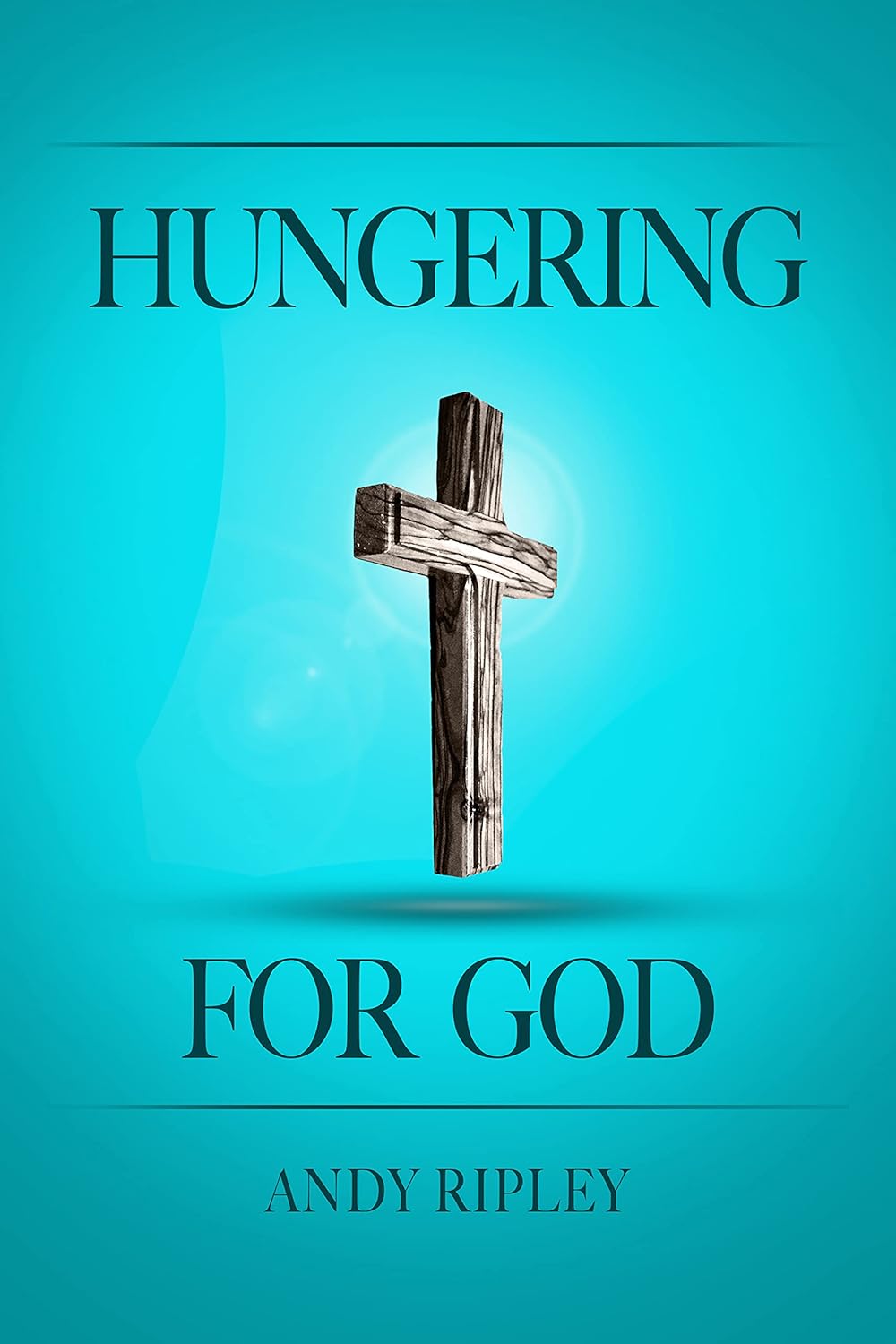
Hungering for God
Andy Ripley
Downtown Angels, summary:
Hungering for God by Andy Ripley is a deeply personal and spiritually rich reflection on the human soul’s longing for something beyond the material — a yearning only God can truly satisfy. With the heart of a seeker and the insight of someone who has wrestled with life’s deepest questions, Ripley invites readers on a journey to rediscover intimacy with God in a world filled with noise, distraction, and spiritual dryness. Through Scripture, prayer, and honest storytelling, he explores what it means to crave God not just in moments of crisis but as a daily posture of the heart.
This book is not merely about religious discipline; it’s about pursuing a relationship with a God who first sought us. Ripley challenges readers to move beyond surface-level faith and embrace a hunger that leads to transformation. Whether you are a seasoned believer or someone feeling spiritually distant, Hungering for God offers a refreshing and heartfelt reminder that the deepest desires of the soul are met not in success or security but in the presence of the living God.
Please click on the link
https://amzn.to/48FaoW7
To continue reading more uplifting articles from Downtown Angels, click the image below.
Esther
Courageous Queen, Strategic Thinker, and Defender of Her People
Esther’s life is a story of bravery, wisdom, and divine timing that continues to inspire believers today. As a Jewish woman raised in exile, she rose to become queen of Persia—a position that placed her at the very heart of power. When the lives of her people were threatened, Esther risked everything, approaching the king without invitation to plead for their survival. Her courage, strategic thinking, and unwavering faith turned a moment of danger into a story of deliverance, showcasing how God works through those willing to act boldly for His purposes.
Esther’s legacy is a testament to the power of faith, influence, and timely action. She reminds us that God can place ordinary people in extraordinary circumstances, calling them to stand firm, speak wisely, and trust His guidance. Her story continues to encourage believers to live courageously and advocate for justice, even when it feels risky or impossible. If you’re inspired by biblical heroes who acted with faith and wisdom, simply click the image below to continue exploring remarkable journeys of courage and devotion.
