
 My Testimony
John Bunyan
The Powerful Story of Faith That Inspired The Pilgrim’s Progress
By Neil McBride, Founder and CEO of Downtown Angels

Early Life and the Seeds of Faith
John Bunyan was born in November 1628 in the small village of Elstow, near Bedford, in Bedfordshire, England. His family belonged to the working class, and his father, Thomas Bunyan, was a brazier or tinker by trade, a craftsman who repaired pots, pans, and other metal household goods. This occupation, though humble and often looked down upon by society, provided Bunyan with a unique perspective on the struggles and resilience of everyday people. These insights would later inform the characters and themes in his writing.
Bunyan’s early life was marked by simplicity and hardship. Education was not easily accessible to working-class families in 17th-century England, and though Bunyan did attend a local grammar school for a short time, his formal education was limited. He would later lament his lack of classical education. Still, his deep engagement with the Bible and keen intellectual curiosity allowed him to develop a rich and articulate theological understanding despite this.
Religiously, Bunyan’s childhood was shaped by the Church of England, but his household was not deeply devout. His exposure to more intense spiritual thought came gradually, often through encounters rather than upbringing. England, during Bunyan’s formative years, was experiencing a turbulent period of religious and political change. The English Civil War (1642–1651), which broke out during his adolescence, pitted Royalists against Parliamentarians, and more significantly for Bunyan, it was also a battleground between different religious ideologies, including Anglicans, Puritans, Presbyterians, and emerging radical sects such as the Baptists and Quakers.
This atmosphere of upheaval undoubtedly impacted the young Bunyan, who joined the Parliamentary army as a teenager during the conflict. While there is limited information about his service, Bunyan later recalled a moment in which he narrowly escaped death when a fellow soldier volunteered to take his place on duty and was killed. Experiences like this may have planted early seeds of spiritual seriousness and questions about divine providence.
Despite these influences, Bunyan himself confessed that in his youth, he was far from godly. In his autobiographical work Grace Abounding to the Chief of Sinners, he offers a candid and unflinching account of his sinful life, describing himself as the “chief” of sinners. He spoke of being consumed by vanity, profanity, and an obsession with what he called “wickedness,” including lying, cursing, and playing sports on Sundays—activities that the Puritans of his day condemned as worldly and irreverent. Although these behaviours might seem minor today, to Bunyan, they represented a heart far from God and in desperate need of redemption.
What is particularly striking about Bunyan’s self-reflection is the depth of his conviction and the emotional turmoil it evoked. He was not simply going through the motions of religion; he was inwardly tormented by the fear that he had committed the unpardonable sin, that he was beyond the reach of God’s grace. He would later describe periods of spiritual despair so intense that he felt as though he were “forsaken of God.”
During this time, Bunyan began encountering individuals and communities who would profoundly shape his spiritual awakening. One pivotal moment occurred when he overheard a group of women in Bedford discussing their faith with a sense of joy and intimacy with God that he had never experienced before. Their conversation stirred something deep within him, and he began seeking the truths they spoke of, eventually joining a local Separatist congregation. This group rejected the formalism of the Church of England and emphasised a personal, experiential faith.
Through these encounters and his growing hunger for spiritual truth, Bunyan began reading the Bible seriously for the first time. The Scriptures awakened in him a sense of both dread and hope. He became aware of the weight of his sin but also the possibility of grace through Jesus Christ. Yet his conversion was anything but immediate. For several years, Bunyan would swing between hope and despair, believing one moment that he was saved and the next that he was doomed.
This intense inner struggle would eventually lead to a profound and enduring faith, but not before many trials of the soul. Bunyan’s early spiritual life was a furnace of fear, conviction, longing, and brokenness, experiences that shaped his theological outlook and would later be masterfully portrayed in the character of Christian, the main figure in The Pilgrim’s Progress. Christian’s journey from the City of Destruction to the Celestial City is, in many ways, an allegory of Bunyan’s path from a guilt-ridden sinner to a redeemed believer.
Even in these early years, we can see the beginnings of the themes that would come to define Bunyan’s life and legacy: the burden of sin, the quest for truth, the struggle between despair and hope, and above all, the power of faith to transform and sustain. It is a testament to God’s grace that someone from such a modest background, plagued with doubt and shame, would go on to become one of the most enduring voices in Christian history.
Conversion
John Bunyan’s faith journey took a decisive and life-altering turn in the late 1640s or early 1650s. This period marked the beginning of one of the most profound and influential spiritual awakenings in Christian history. For Bunyan, conversion was not a single emotional event but a gradual, often painful transformation—an inward pilgrimage that would lay the foundation for his life’s work and spiritual legacy.
Bunyan’s account of his conversion, recorded in his spiritual autobiography Grace Abounding to the Chief of Sinners, reveals the depth of his internal struggle. He was a man tormented by an acute awareness of his sinfulness. Every aspect of his past, his blasphemous speech, his disregard for the Sabbath, his pride, and even his moments of religious self-righteousness, weighed heavily on his conscience. He began to see his entire life through the lens of divine judgment. In his mind, he was not merely a sinner; he was the worst of sinners, irredeemable and condemned.
What followed was not an immediate deliverance into peace but rather a prolonged season of spiritual agony. Bunyan described being haunted by Scripture passages that seemed to confirm his damnation. Verses such as Hebrews 6:4–6 and Hebrews 10:26–27 pierced him with fear that he had committed the “unpardonable sin” and had been cut off from salvation. He would obsess over these verses, reading them again and again, only to fall deeper into despair. There were moments when he believed he had been utterly forsaken by God, abandoned like Esau, and left to face eternal punishment.
Yet, amid this darkness, rays of hope began to shine through. Other passages of Scripture, particularly those that spoke of Christ’s mercy and God’s grace toward sinners—would occasionally bring him comfort. Verses like John 6:37, “All that the Father gives me will come to me, and whoever comes to me I will never cast out,” became lifelines in his spiritual storm. He clung to these promises, even when his heart doubted their truth. This tension between fear and hope, guilt and grace, became the spiritual battleground of his soul.
Importantly, Bunyan’s conversion was marked by intense introspection and spiritual wrestling, not outward displays of religious enthusiasm. This distinguishes him from many who experienced emotional “revival” moments. His was a conversion forged slowly in the fires of inner conflict and divine encounter. He was being remade not just in belief but in the entire orientation of his heart and mind.
As Bunyan gradually came to understand and accept the message of the gospel—that salvation is by grace alone, through faith in Jesus Christ his spiritual chains began to loosen. The burden of guilt he had carried for so long began to lift, much like the character Christian in The Pilgrim’s Progress, who loses his burden at the foot of the cross. Though Bunyan would continue to face spiritual doubts and temptations throughout his life, he had found a sure foundation in Christ and a purpose that would drive everything he did from that point forward.
This newfound faith led Bunyan to formally align himself with a group of believers outside the established Church of England. He joined a local Separatist or Nonconformist congregation in Bedford, a group committed to the purity of New Testament Christianity and unencumbered by the hierarchy and liturgical structure of the Anglican Church. This community emphasised personal holiness, biblical literacy, and the priesthood of all believers. It was here that Bunyan began to grow not only in faith but also in influence.
He started by attending services regularly, studying the Scriptures more diligently, and participating in the life of the congregation. Soon, others noticed his spiritual maturity and his compelling way of expressing biblical truths. Despite having little formal education, Bunyan possessed a remarkable ability to communicate profound theological concepts through simple, relatable language. Eventually, he began preaching first informally and then as a recognized lay preacher. His sermons drew crowds from nearby villages, not because he was eloquent in the traditional sense but because he spoke with conviction, clarity, and authenticity.
Bunyan’s theology, shaped by both his personal experiences and the teachings of Puritanism, centred on grace, human depravity, and the necessity of perseverance in the Christian life. He believed that true faith was not a passive acceptance of doctrine but an active, lived experience. For Bunyan, the Christian life was a pilgrimage marked by trials, temptations, and spiritual warfare, yet sustained by divine mercy, hope, and the assurance of eternal life.
His commitment to Christ and the Nonconformist cause came at a cost. In the years that followed his conversion, Bunyan would face intense persecution, including lengthy imprisonment, for preaching without a license and refusing to conform to the state church. Yet he never wavered. His faith, born in agony and nurtured in the crucible of self-examination and Scripture, had taken root deeply within him. It would carry him through his most difficult trials and inspire a body of work that continues to minister to hearts and souls across centuries.
Faith Amid Persecution: Bunyan’s Imprisonment
John Bunyan’s faith, already tested through personal trials and inner battles, would be forged even more powerfully in the fires of public persecution. Following the Restoration of King Charles II in 1660, England began a renewed era of religious conformity under the Church of England. Laws were enacted to suppress dissenting voices, particularly among Puritans, Baptists, Quakers, and other Nonconformists who refused to adhere to the doctrines, practices, and authority of the Anglican Church.
The Act of Uniformity of 1662 was one of the harshest measures, requiring all ministers to use the Book of Common Prayer and to receive episcopal ordination. Those who refused to comply were ejected from their pulpits, silenced, and often faced criminal charges. For Bunyan, whose deep convictions as a Separatist Christian led him to believe in preaching the gospel freely and according to conscience, compliance was never an option.
In November 1660, Bunyan was arrested while preaching at a private gathering in a farmhouse in Lower Samsell, Bedfordshire. He was charged with “unlawful assembly” and preaching without a license—a violation of the Conventicle Act. Despite being given opportunities to recant or agree to stop preaching, Bunyan resolutely refused to do so. His faith in God and his call to proclaim the gospel would not allow him to compromise.
What followed was a lengthy and gruelling imprisonment in the Bedford County Gaol. Although the original sentence was for three months, Bunyan ultimately spent about twelve years in prison, from 1660 to 1672 (with a brief release in between). During this time, he was separated from his wife and children, including a blind daughter to whom he was especially close. The emotional weight of this separation was immense, and Bunyan later wrote of the “pulling of the flesh” he felt each time he thought of his family’s suffering without him.
The prison conditions were harsh, cold, unsanitary, and often overcrowded. Food was scarce, and disease was a constant threat. Yet rather than breaking his resolve, these hardships became the crucible in which Bunyan’s faith was deepened, purified, and magnified. He later wrote that though prison was painful, it was also a place of great spiritual blessing, stating, “I was at home in prison, and I sat me down and wrote and wrote, for the joy that came into my heart.”
He spent his days reading the Bible, meditating on Scripture, praying, and writing. He also continued to minister to others, both through his writings and his conversations with fellow inmates and prison visitors. Bunyan did not view prison as an obstacle to his calling but as a platform uniquely designed by God to advance it. Indeed, some of his most significant works were written during this period, including “Grace Abounding to the Chief of Sinners” and his magnum opus, “The Pilgrim’s Progress.”
It was during these years in confinement, amid physical limitations and emotional suffering, that Bunyan’s creative imagination and theological insight flourished. His writing became a lifeline for countless Christians then and now, struggling to make sense of suffering, temptation, and the path of faith.
The Pilgrim’s Progress: Faith Embodied in Allegory
Published in 1678, six years after Bunyan’s release from prison, The Pilgrim’s Progress quickly became a monumental success. Widely regarded as the first great work of English Protestant literature, it was printed in over 100 editions during Bunyan’s lifetime alone and has since been translated into more than 200 languages. But its impact was not merely literary; it was, and remains, deeply spiritual.
At its heart, The Pilgrim’s Progress is an allegory —a spiritual narrative that employs symbolic characters, places, and events to portray the Christian life. The story follows a man named Christian, who sets out from his home in the “City of Destruction” after reading a book (representing the Bible) and realising his soul is in grave peril. Burdened by the weight of his sins, Christian embarks on a journey to the “Celestial City,” which represents Heaven. Along the way, he encounters numerous challenges that mirror the spiritual battles believers face: doubt, fear, temptation, worldly distractions, false teachings, and despair.
Characters like Evangelist, Faithful, Hopeful, Mr. Worldly Wiseman, and Giant Despair represent spiritual conditions or influences that Christians must either follow or resist. Locations such as the Slough of Despond, Vanity Fair, the Delectable Mountains, and the Valley of the Shadow of Death create a rich allegorical landscape drawn from Bunyan’s deep knowledge of Scripture and his own spiritual experiences.
Christian’s journey is not a straight path but a pilgrimage filled with setbacks and breakthroughs, discouragement and encouragement—much like Bunyan’s own life. The burden Christian carries symbolises the weight of guilt and sin, which is only removed when he comes to the foot of the cross. This moment of release and renewal is one of the most powerful scenes in the book, encapsulating Bunyan’s theology of grace and redemption.
The strength of The Pilgrim’s Progress lies in its simplicity and universality. Though written in 17th-century English, the book speaks directly to the human condition: the struggle for purpose, the need for hope, the pain of trials, and the joy of salvation. Bunyan does not write as a detached theologian but as a fellow traveller, someone who has walked through valleys of doubt and despair and has emerged, by grace, with enduring faith.
Through this allegory, Bunyan also teaches essential Christian doctrines, including justification by faith alone, the perseverance of the saints, the dangers of false teaching, and the comfort of divine providence. Yet he does so not with rigid dogmatism but through vivid storytelling that invites the reader to see themselves in Christian’s shoes.
Moreover, The Pilgrim’s Progress reflects Bunyan’s compassion for fellow believers. He knew what it meant to feel lost, to doubt God’s promises, and to wrestle with fear. In writing this allegory, he provided not only a theological roadmap but a pastoral companion, something to guide and comfort readers on their spiritual journeys.
Theology of Grace and Redemption
At the heart of John Bunyan’s faith was an unshakable belief in the doctrine of grace and redemption, a belief that not only shaped his theological outlook but also deeply coloured his journey of salvation and spiritual growth. For Bunyan, the central truth of the Christian life was that salvation is a sovereign act of God’s mercy, extended not to the worthy or the righteous but to sinners in need of grace.
This conviction aligned with the broader Puritan and Reformed theological tradition, which emphasised human depravity and divine sovereignty. Bunyan taught, without apology, that humanity is inherently fallen, utterly incapable of saving itself, and that any hope of redemption lies not in religious ritual, moral behaviour, or human merit but entirely in Christ’s atoning sacrifice on the cross. His theology was saturated with the awareness of sin, not as an abstract concept but as a personal, tormenting reality that only the blood of Jesus could cleanse.
What distinguished Bunyan, however, was not only his doctrinal clarity but the pastoral warmth with which he conveyed these truths. Having personally experienced the crushing burden of guilt and the liberating joy of forgiveness, he wrote as one who had walked the road from despair to grace. His works—particularly Grace Abounding to the Chief of Sinners do not offer a detached theological analysis but a deeply intimate testimony of God’s redemptive work in his own life.
Bunyan’s theology emphasised the imputed righteousness of Christ—the belief that, through faith, the perfect righteousness of Jesus is credited to the believer. This was the cornerstone of his hope. He often portrayed the believer as clothed in Christ’s righteousness, sheltered from judgment not because of their worthiness but because of their union with the Saviour. As he wrote, “He that is down need fear no fall,” pointing to the humble dependence of a believer on God’s grace alone.
But Bunyan’s view of grace was not a license for complacency. He fully acknowledged the ongoing battle against sin in the believer’s life. He described the Christian journey as filled with dangers and temptations from the world, the flesh, and the devil. His characters, such as Christian and Faithful, struggle, fall, get back up and press on toward the Celestial City. In Bunyan’s world, grace does not eliminate the struggle. It empowers perseverance. Victory is not found in personal strength but in the indwelling power of the Holy Spirit, which enables believers to endure hardship, resist temptation, and walk in holiness.
The Role of Scripture and Prayer
Bunyan’s deep spiritual life was sustained by two essential disciplines: Scripture and prayer. These were not mere religious duties for him but the lifeblood of his faith, through which he communed with God and received strength for the journey.
Though he lacked extensive formal education, Bunyan became remarkably fluent in Scripture. His writings are filled with biblical references, themes, and imagery, often woven into the fabric of his allegories and sermons with poetic brilliance. He didn’t simply quote the Bible. He lived in it. The Bible was, for him, the supreme authority in matters of life and doctrine, and he encouraged all believers to engage deeply with it.
In prison, cut off from society and the church community, Bunyan turned to the Scriptures with even greater earnestness. He read and meditated on them daily, treasuring them as his source of wisdom and comfort. In those solitary years, the Word of God was his companion and counsellor. He found in its pages not only the story of redemption but the very presence of Christ.
Alongside Scripture, prayer played a central role in Bunyan’s spiritual life. It was both a means of communication with God and a weapon of warfare against the spiritual trials he faced. He often described prayer as the “sighing of the soul,” a heartfelt outpouring of one’s deepest needs, fears, and hopes before a merciful God. Whether in joy or despair, Bunyan turned to prayer—not as a last resort, but as a natural expression of his relationship with God.
In his prison writings, Bunyan speaks of prayer with vivid intensity, describing moments when his spirit soared despite his chains. He viewed prayer not as an obligation but as a gift of access to the throne of grace—a holy privilege purchased by the blood of Christ. It was in prayer that he found the courage to face another day, hope to endure suffering, and clarity to write words that would echo across the ages.
Impact and Legacy
John Bunyan’s faith, so deeply personal and so profoundly theological, did not end with his life. It transformed the spiritual landscape of the Christian world. His writings, most notably The Pilgrim’s Progress, became household staples across England and eventually the globe. For generations, his voice has encouraged believers to persevere, trust in God’s grace, and press forward toward eternal life.
The Pilgrim’s Progress has never been out of print since its initial publication in 1678. Translated into over 200 languages and adapted into countless formats, it remains one of the most widely read books in the world after the Bible. Its reach is not limited to one denomination or tradition; Catholics, Protestants, Evangelicals, and even secular readers have found in its pages a timeless story of human struggle and divine redemption.
But Bunyan’s legacy extends far beyond his literary fame. He became a model of courageous nonconformity, choosing obedience to God over obedience to oppressive religious laws. He suffered not for rebellion but for conscience, refusing to be silent when the gospel called him to speak. His willingness to endure prison for his beliefs inspired later generations of Christians facing persecution, from the early Baptists and Methodists to those suffering under modern regimes.
Bunyan’s faith was marked by humility and authenticity. Despite his influence, he never considered himself a great theologian or saint. He saw himself as a “lowly tinker” who had been touched by God’s mercy. His story is a reminder that God uses the humble, the broken, and the unlikely to accomplish great things for His kingdom.
In modern evangelical and Protestant traditions, Bunyan’s emphasis on personal faith, assurance of salvation, the soul’s pilgrimage, and the sufficiency of grace remains foundational. His legacy lives on not only through his books but through the countless lives changed by his message of hope.
Conclusion: A Faith That Endures
John Bunyan’s life is a profound testimony to the enduring power of faith—faith that is forged in adversity, refined by Scripture, and anchored in grace. From a troubled, guilt-ridden young man to a bold preacher, a faithful prisoner, and a beloved author, his journey reflects the transforming work of God in the human soul.
Bunyan’s path was not easy. It was marked by inner turmoil, external persecution, and prolonged suffering. Yet, through it all, his faith remained unwavering. It deepened. He learned to trust not in his righteousness but in Christ’s. He came to understand that salvation is not a prize for the pious but a gift for the penitent. And he never stopped pointing others to that same grace.
His life and work remind us that the Christian journey is indeed a pilgrimage, a path filled with trials, doubts, and detours, yet also with beauty, grace, and unshakable hope, for those who, like Christian in The Pilgrim’s Progress, press on through the valleys of despair and the hills of joy, there awaits a Celestial City, where God’s promises are fulfilled, and His presence is eternal.

Pilgrim’s Progress
John Bunyan
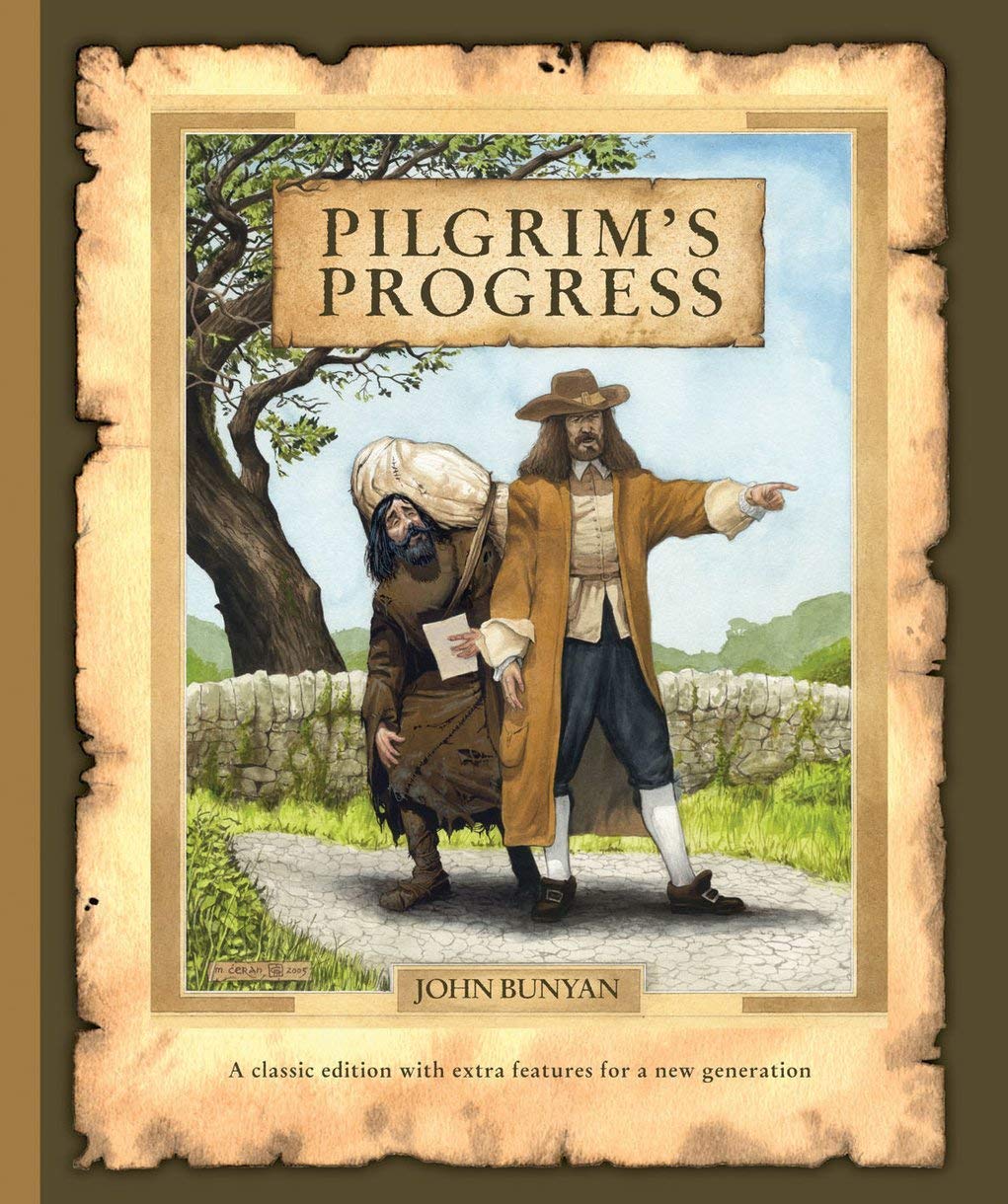
Downtown Angels, summary:
Pilgrim’s Progress, written by John Bunyan in the 17th century, is one of the most influential works of Christian literature. Presented as an allegory, the story follows the journey of a man named Christian as he leaves the City of Destruction in search of salvation, represented by the Celestial City. Along the way, he faces numerous challenges, temptations, and trials, from the Slough of Despond to Vanity Fair, each symbolising a different aspect of spiritual struggle. His path is both physical and spiritual, reflecting the inner transformation that accompanies true faith.
Bunyan’s work is deeply rooted in his Puritan beliefs, but its themes of perseverance, faith, and redemption resonate universally. Through Christian’s journey, Bunyan explores the challenges of remaining faithful to one’s beliefs in a world full of distractions and dangers. The story’s enduring relevance lies in its portrayal of the human condition: the longing for purpose, the burden of guilt, and the hope for eternal peace. Though written in the language of its time, Pilgrim’s Progress continues to speak powerfully to readers navigating their own spiritual or moral paths.
Please click on the link
https://amzn.to/4iMJOzl
Hungering for God
Andy Ripley

Downtown Angels, summary:
Hungering for God by Andy Ripley is a deeply personal and spiritually rich reflection on the human soul’s longing for something beyond the material — a yearning only God can truly satisfy. With the heart of a seeker and the insight of someone who has wrestled with life’s deepest questions, Ripley invites readers on a journey to rediscover intimacy with God in a world filled with noise, distraction, and spiritual dryness. Through Scripture, prayer, and honest storytelling, he explores what it means to crave God not just in moments of crisis but as a daily posture of the heart.
This book is not merely about religious discipline; it’s about pursuing a relationship with a God who first sought us. Ripley challenges readers to move beyond surface-level faith and embrace a hunger that leads to transformation. Whether you are a seasoned believer or someone feeling spiritually distant, Hungering for God offers a refreshing and heartfelt reminder that the deepest desires of the soul are met not in success or security but in the presence of the living God.
Please click on the link
https://amzn.to/48FaoW7
To continue reading more uplifting articles from Downtown Angels, click the image below.
Dwight L. Moody
Legendary Leader in Evangelism & Faith
Dwight L. Moody stands as one of the most influential evangelists of the 19th century—a man whose simple, heartfelt preaching transformed lives across America and Britain. Raised with little formal education, Moody nevertheless carried a burning desire to share Christ with everyone he met. His revival meetings drew thousands, not because of eloquent rhetoric, but because of his authenticity, compassion, and unwavering belief in the power of the gospel. Through his work, countless souls came to faith, and communities were spiritually renewed.
Moody’s legacy reaches far beyond his evangelistic campaigns. He founded churches, schools, and institutions that continue to shape Christian ministry today, including the Moody Bible Institute. His vision for ordinary believers to live extraordinary lives for Christ remains both inspiring and challenging. If you’re eager to dive deeper into the stories of world-changing Christian leaders, click the image below and continue exploring.
