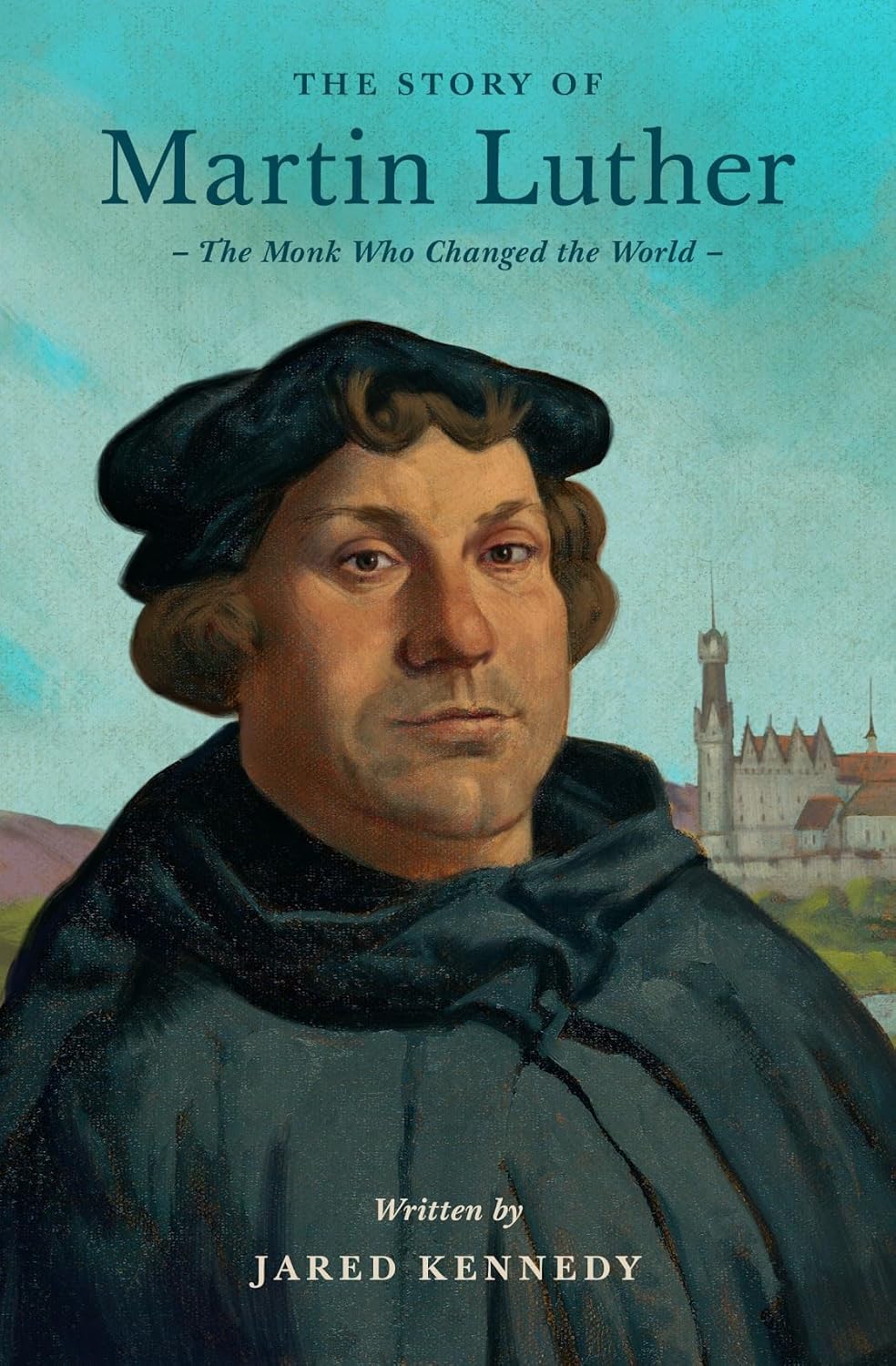
Early Life and Education (1483–1505)
Martin Luther was born on November 10, 1483, in the small mining town of Eisleben, located in the County of Mansfeld within the Holy Roman Empire. His parents, Hans Luder, a hardworking miner and smelter, and Margarethe Lindemann, provided a modest but nurturing upbringing. Shortly after his birth, the family moved to the nearby town of Mansfeld, where they lived humbly, reflecting his father’s working-class status. Hans would later become involved in local governance, serving on the town council, which suggests the family’s steady, though not affluent, social standing.
Luther was baptized the day after his birth and was named after St. Martin of Tours, a saint known for his acts of charity, which may have subtly influenced Luther’s early religious sensibilities. From an early age, Luther’s education was marked by a rigorous and disciplined approach to learning. At the age of five, he began attending a Latin school, where he was introduced to classical languages and Christian teachings.
By the time he was thirteen, Luther had enrolled at a school run by the Brethren of the Common Life in Magdeburg, an influential religious community dedicated to personal piety and devotion to Scripture. He later attended a local Latin school in Eisenach, where the foundations for his spiritual and intellectual growth were laid. These formative years instilled in Luther a deep reverence for the Bible, a commitment to personal holiness, and a serious, ascetic discipline in both study and life. In 1501, Luther matriculated at the University of Erfurt, one of the most prestigious institutions of the time, where he advanced rapidly, earning his Bachelor’s degree in 1502 and his Master’s degree in 1505. Despite his father’s hopes that he would pursue a career in law, Luther’s growing spiritual convictions increasingly drew him toward a religious vocation.
Monastic Vocation and Early Theology (1505–1512)
In July 1505, a life-altering event transformed Luther’s path. Caught in a violent thunderstorm while travelling near Stotternheim, he was terrified by a lightning strike that seemingly threatened his life. In desperation, Luther cried out, “Help, St. Anne!” vowing that if he survived, he would become a monk. True to his promise, he immediately entered the Augustinian monastery in Erfurt, dedicating himself to a life of rigorous monasticism. This decision was not taken lightly; Luther sought assurance of salvation through intense acts of confession, fasting, prayer, and self-denial, striving to meet what he perceived as the impossibly high standards of divine holiness.
Despite his earnest efforts, Luther’s early years as a monk were marked by profound spiritual struggle and anxiety. He felt overwhelmed by a persistent sense of unworthiness and guilt, convinced that no amount of religious observance could fully reconcile him with God. This period of inner turmoil would deeply shape his later theological insights. Ordained as a priest in 1507, Luther was soon sent to the University of Wittenberg, where he continued his theological studies and began teaching.
His intellectual breakthrough came after receiving his Doctorate in Theology on October 21, 1512. As a professor, he devoted himself to the study and teaching of Scripture, with a particular focus on the letters of Paul, especially the Epistle to the Romans. It was through these studies that Luther began to develop his doctrine of sola fide, justification by faith alone, which would become the cornerstone of his challenge to the prevailing teachings of the Catholic Church and ignite the Protestant Reformation.
The Indulgence Controversy and the 95 Theses (1515–1517)
By 1515, the Catholic Church was deeply involved in fundraising efforts to finance the grand construction of St. Peter’s Basilica in Rome. Pope Leo X and Archbishop Albert of Mainz appointed Johann Tetzel, a Dominican friar, to sell indulgences across Germany. These indulgences were essentially certificates that promised buyers the remission of sins or the release of loved ones from purgatory, often depicted as a means to “buy” salvation or reduce the time spent in the afterlife’s cleansing fire. Tetzel’s methods were aggressive and theatrical, employing slogans like, “As soon as a coin in the coffer rings, the soul from purgatory springs.” This blatant commercialisation of forgiveness deeply troubled Martin Luther, who viewed it as a gross distortion of Christian doctrine and a cynical exploitation of vulnerable believers.
On October 31, 1517, in response to the indulgence campaign, Luther composed his Ninety-five Theses, formally titled Disputation on the Power and Efficacy of Indulgences. Written in scholarly Latin, the document posed a critical theological challenge, questioning the legitimacy of indulgences, the Pope’s authority to grant such pardons, and the very idea that salvation could be bought or sold. While popular legend holds that Luther famously nailed the theses to the door of the Wittenberg Castle Church, historians now believe he may instead have sent them to church authorities or circulated them among academic circles. Regardless, the Ninety-five Theses quickly caught fire, being translated into German and printed within weeks. This rapid spread ignited intense debate among scholars, clergy, and laypeople alike, marking the beginning of a revolutionary religious movement.
A Spirited Disputation and Break with Rome (1518–1521)
In April 1518, Luther participated in the Heidelberg Disputation, a formal academic debate in which he articulated his emerging theological ideas, particularly concerning sin, grace, and the “bondage of the will.” He argued that human will is not free to achieve salvation without divine grace, directly challenging prevailing Church teachings. His passionate defence earned him allies, such as Martin Bucer and other reform-minded theologians, signalling a shift from academic controversy to broader public unrest.
Later that year, the Pope sent Cardinal Cajetan to Augsburg to demand that Luther recant his criticisms of the Church. Luther, however, stood firm and refused to withdraw his teachings, then fled back to Wittenberg to avoid arrest. The confrontation escalated in 1520, when Pope Leo X issued the papal bull Exsurge Domine, condemning Luther’s doctrines and demanding a retraction under threat of excommunication. Luther publicly burned the bull, a bold act of defiance that led to his formal excommunication.
In 1521, Luther was summoned to the Diet of Worms, an imperial assembly presided over by Emperor Charles V. There, he was asked to renounce his writings and teachings. Luther’s legendary response, “Here I stand; I can do no other,” encapsulated his unwavering commitment to Scripture as the ultimate authority over Church tradition and papal edicts. Declared an outlaw by the Edict of Worms, Luther faced grave danger but was protected by Frederick the Wise, Elector of Saxony, who arranged for Luther to be hidden at Wartburg Castle.
Wartburg Exile and Bible Translation (1521–1522)
During his enforced exile at Wartburg Castle, Luther turned his attention to one of his most enduring legacies: making the Bible accessible to ordinary people. Understanding that most laypeople could neither read Latin nor afford expensive copies of Scripture, Luther undertook the monumental task of translating the New Testament directly from the original Greek into clear, everyday Saxon German. In just eleven weeks, he completed this remarkable translation, which was published in 1522 as the September Bible. Luther’s translation was revolutionary. Not only did it democratize access to God’s Word, but it also resonated emotionally and spiritually with the common people, fostering a more personal relationship with faith.
Luther’s work on the Bible didn’t stop there. Over the next decade, he continued translating the Old Testament from Hebrew, culminating in the publication of the complete German Bible in 1534. This comprehensive translation played a critical role in promoting literacy and education, as people now had a compelling reason to learn to read. Additionally, Luther’s Bible helped standardise the German language, uniting disparate dialects into a more uniform linguistic form. Spiritually, it empowered laypeople to engage directly with Scripture, thereby reducing clerical control over religious knowledge and encouraging personal interpretation and devotion. Through this monumental work, Luther’s impact extended far beyond theology into the cultural and social fabric of Europe.
Reforming Theology and Church Practice
Following his initial challenge to indulgences, Martin Luther developed a comprehensive theological framework that would fundamentally reshape the Christian faith. Central to his reforms was the doctrine of sola scriptura, the belief that Scripture alone, not Church tradition or papal authority, should be the ultimate guide for Christian faith and practice. Luther argued that the Bible contains all necessary truths for salvation and that every believer should have direct access to its teachings. Complementing this was sola fide, the conviction that salvation is attained through faith alone rather than through human works or merits.
These, along with sola gratia (grace alone), Solus Christus (Christ alone), and soli Deo Gloria (to the glory of God alone), became known as the Five Solas, foundational principles for Protestant theology.
Luther also reexamined the nature of the Eucharist, rejecting the Catholic doctrine of transubstantiation—which teaches that the bread and wine become the body and blood of Christ—and instead taught the doctrine of the “real presence.” He insisted that Christ is truly present “in, with, and under” the bread and wine, a view now known as the doctrine of the sacramental union. This nuanced stance sought to preserve reverence for the sacrament while distancing itself from what it deemed unnecessary philosophical speculation.
Further, Luther challenged the strict division between clergy and laity, asserting the “priesthood of all believers.” He believed every Christian has direct access to God without the need for priestly intermediaries, thereby promoting spiritual equality and encouraging lay participation in worship and church life. To support this, Luther advocated for the use of the vernacular in preaching and liturgy, insisting that worship and Scripture be accessible in the common tongue so that all could understand and engage with the faith. He was also a strong proponent of education, arguing that schools should be widely available to teach not only religious doctrine but also literacy and critical thinking, thus benefiting both spiritual growth and society at large.
Social Turmoil and Religious Warfare
The sweeping religious ideas unleashed by the Reformation had far-reaching social consequences, often sparking unrest and conflict beyond the spiritual realm. One of the most significant upheavals was the German Peasants’ War (1524–1525), a widespread uprising by peasants and lower-class farmers demanding economic relief, social reforms, and greater freedoms. Many peasants drew inspiration from Reformation rhetoric about Christian liberty and equality, hoping that Luther’s teachings might justify their calls for justice.
However, Luther’s reaction was complex and, at times, deeply contradictory. While sympathetic to some of the peasants’ grievances, he vehemently condemned the rebellion in his pamphlet Against the Murderous and Robbing Hordes of the Peasants (1525). Luther firmly sided with the ruling authorities, urging them to suppress the revolt harshly to maintain social order. This stance revealed the tension between Luther’s revolutionary religious ideas and his conservative views on political stability, highlighting how the Reformation could be both a movement of spiritual renewal and a catalyst for societal conflict.
Personal Life and Later Years
In a dramatic and symbolic break from the Catholic tradition of clerical celibacy, Martin Luther married Katharina von Bora in 1525. Katharina was a former nun who had escaped the convent, and their marriage became a powerful model for Protestant family life. Together, they raised six children, four of whom survived to adulthood, underscoring Luther’s importance of the family as a spiritual and social institution. Their household was renowned for its warmth, hospitality, and disciplined piety, reflecting Luther’s conviction that the Christian faith should permeate every aspect of daily life.
Throughout his later years, Luther remained an active theologian and public figure. He produced important confessional writings such as the Schmalkaldic Articles and helped shape the Smalcald League’s theological positions, which united Protestant princes against Catholic opposition. Luther also engaged in numerous debates with both radical reformers and Catholic defenders, consistently defending his vision of the Christian faith. Beyond theology, his influence extended to music (promoting congregational singing), education (founding schools and advocating literacy), and civic life, shaping the cultural landscape of Protestant Europe.
However, Luther’s legacy is also marred by darker aspects. In 1543, he authored On the Jews and Their Lies, a deeply antisemitic tract that called for the destruction of synagogues, the expulsion of Jews from Christian lands, and even violent measures against Jewish communities. These reprehensible writings contributed to a legacy of hostility toward Jews in German-speaking lands and were later exploited by nationalist and Nazi ideologies centuries after his death. This aspect of Luther’s thought remains a troubling part of his historical record, complicating his role as a religious reformer and cultural figure.
Death and Memorialization
Martin Luther died on February 18, 1546, in his birthplace, Eisleben, at age 62, likely from a heart attack. His final moments were marked by the same unwavering commitment to his faith and principles that had defined his entire life. Despite years of controversy, threats, and political turmoil, Luther remained steadfast in his conviction that Scripture and faith held ultimate authority over all human institutions. His death in Eisleben, where his life had both begun and ended, was a symbolic closing of a chapter that forever altered the course of Christian history.
Today, the town of Eisleben honours Luther’s memory with several preserved sites connected to his life, including the house where he was born and the one where he died. These locations form part of a broader UNESCO World Heritage designation that also includes Wittenberg, where Luther posted his Ninety-five Theses and began his teaching career. Together, these memorials draw thousands of visitors each year, serving as places of pilgrimage and historical reflection. They stand not only as tributes to Luther’s profound influence but also as reminders of the turbulent era he helped shape, preserving the legacy of the Reformation for future generations to study and contemplate.
Conclusion
Martin Luther’s journey from a fearful, guilt-ridden monk to one of the most audacious reformers in history represents a dramatic transformation that reshaped Christianity and Western civilisation. His theological innovations, centred on the principles of sola fide (faith alone), sola gratia (grace alone), and sola scriptura (Scripture alone), challenged centuries of established Church doctrine and authority. By promoting the use of the vernacular in worship and Scripture, and by advocating widespread education, Luther empowered ordinary people to engage directly with their faith, fostering a cultural shift that rippled beyond the Church into language, literacy, and societal norms.
Yet Luther was a figure full of profound contradictions. He was deeply devout and driven to reform the Church from within, yet his methods and rhetoric could be fiercely confrontational and polarising. While revolutionary in theology, he often maintained conservative views on political order and social hierarchy, as evidenced by his harsh condemnation of the Peasants’ War. Most troublingly, Luther’s legacy includes virulent antisemitism, particularly reflected in his later writings like On the Jews and Their Lies, which have stained his reputation and serve as a cautionary reminder of how even influential leaders can propagate harmful ideologies.
Despite these complexities, Luther’s impact is undeniable and far-reaching. The Reformation not only transformed religious beliefs and practices but also profoundly influenced the development of modern languages, education systems, political thought, and cultural identities across Europe and beyond. The tensions he exposed between individual conscience and institutional authority continue to resonate in religious and secular debates worldwide. Luther’s life and work remain a testament to the power of faith-driven conviction to both inspire monumental change and reveal human imperfection.

 My Testimony